VMware vSphere
Virtualisation platform for a secure and stable cloud
VMware vSphere is a virtualisation platform from VMware that we use for cloud hosting with any operating system.
VMware vSphere Features
Migrating at runtime
Thanks to the vMotion function, it is possible to migrate individual virtual machines between different physical servers. Storage vMotion, in turn, allows you to move data between disk arrays without having to shut them down.
User-friendly
For more convenient control, the vCloud Director portal is available for VMware vSphere, which allows easy cloud management even for less advanced users. It is also available from a web browser.
High Availability
As for the Fault Tolerance function, the contents of one virtual machine are mirrored to another machine, which also runs on another server. If one of the servers fails, the smooth running of the cloud is ensured.
Externally Stored Data
For cloud solutions with VMware vSphere virtualisation, data is not stored on server disks, but on external redundant disk arrays. The data is stored separately from the servers, which reduces the risk of loss.
Well-Arranged Updates
In the vCenter Server administration interface, you can easily find out what updates are currently available and what happens after they have been installed. The functionality thus makes it easier to schedule updates.
User-Access Administration
Different roles and permissions can be assigned to individual accounts. VMware vSphere also includes a detailed log of all user activity, allowing you to perform thorough security audits.
VMware vSphere virtualisation architecture
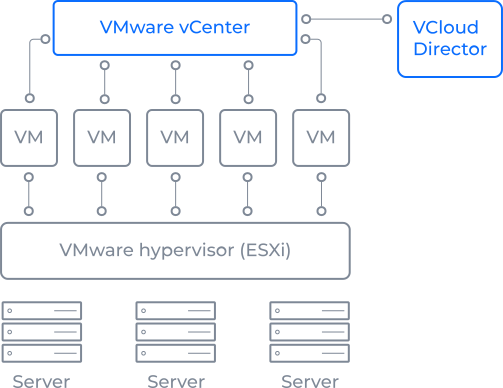
The VMware vSphere platform consists of two basic parts:
- Hypervisor ESXi, which performs full virtualisation of physical servers and creates individual virtual machines from them.
- VMware vCenter manages interconnected servers in the so-called VMware cluster and thus creates individual cloud solutions.

Cloud hosting with a 99.99% availability guaranteed
VMware vSphere technology ensures high availability of cloud services. Thanks to the mirroring of the content of individual virtual machines and intelligent data transfer in the event of a server failure, it is possible to guarantee the availability of cloud hosting up to 99.99%. This means that the maximum time of unexpected unavailability of the cloud server is less than 53 minutes per year.

Supported functions of virtualisation technologies
Full virtualisation | OS Virtualisation | |
|---|---|---|
Platforms | KVM, Hyper-V a VMware | LXC |
Embedded Virtualisation ?Embedded Virtualisation facilitates virtualising VPS and thus enables to create other virtual machines inside of it. | ||
Containerization (Docker) | ||
Kernel Module ?Kernel Module requires some of the more advanced applications and services such as DRBD (Distributed Replicated Storage System, which uses linux platform core). | ||
Kernel Versions | Private | Shared |
Why is cloud better (an more expensive) than a common VPS?
The core of the cloud and VPS are virtualised physical servers. However, when it comes to cloud, more advanced technologies are used. These enable data mirroring, working when the server fails, and data storage on an external disk array. Thanks to this, the cloud is a much more secure service with high guaranteed availability, which is also suitable for frequent scaling.

Connect with our team today to discuss your needs and schedule a meeting.
- +420 515 919 805
- sales@master.cz
You might be interested in

One-click connectivity is as simple as it sounds. Without needing to build network infrastructure, you can connect to any cloud in the world with just a few clicks. So, how can you leverage it for the benefit of your business?

When you google “what is a virtual machine”, you will get back results such as virtual servers, virtual networks, etc. But if you do not have a piece of basic knowledge on this topic, trying to understand the elements that make up the architecture of virtualization can be a bit confusing. In this article, we try […]

What advantages does a private cloud have? The answer is still unknown for many users. You might need a private cloud right now and you may not even know it. There are many factors that influence the decision to hire a private cloud service. Everything will depend on the needs of your company and the […]